Making an AI video-analytics platform feel like one product
Hoopoz watches video across social media for brands: mentions, sentiment, ad compliance, in real time. The technology underneath is heavy. The people using it are brand managers who need a clear answer, not a model-configuration screen. I was hired to redesign the core surfaces so the platform stopped feeling like five tools sharing a login.
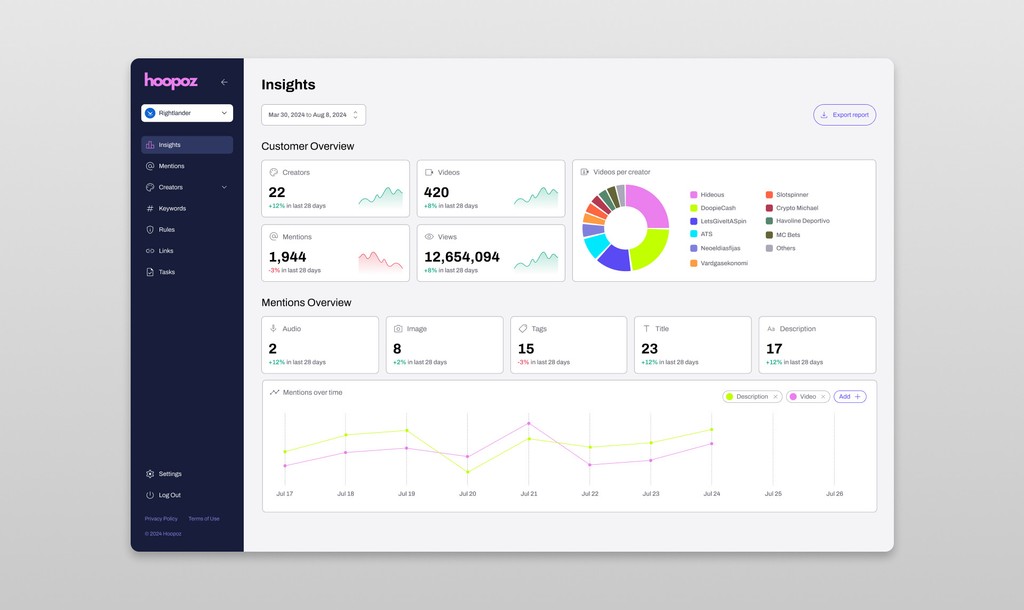
The product had grown one feature at a time. Each new capability shipped as its own surface with its own navigation and its own visual patterns, so by the time I arrived users had to learn five ways to look at fundamentally similar data.
Gave the platform one calm, consistent voice: a left rail as the navigation spine everywhere, one content column instead of a grid of competing widgets, and the same card and interaction patterns across analytics, search, sentiment and compliance. Inside the existing brand, not a new one.
Touch the AI or change what the product could do. The brief was coherence, and adding features would have made it worse.
The redesigned surfaces were handed to the Hoopoz team, who took over the production build. The deliverable was a clear product direction and a system that could take whatever features came next.
The brand book as a constraint, not a canvas
Hoopoz already had a confident identity: purples, a friendly wordmark, warm accents. The tempting move on a redesign is to propose a new direction. I committed to the book instead and used those palettes to give the dashboards some warmth, rather than the default grey that most analytics tools settle into. Working inside the constraint produced better answers than a blank canvas would have.
Clarity first, density second
Every redesigned screen was built around one question: what is this person trying to learn right now? The Insights dashboard answers the commonest one, “is this campaign actually working?”, in the first three seconds. The granular data is still there for anyone who wants to drill in. Overall density went down; the amount of useful information people could actually absorb went up.
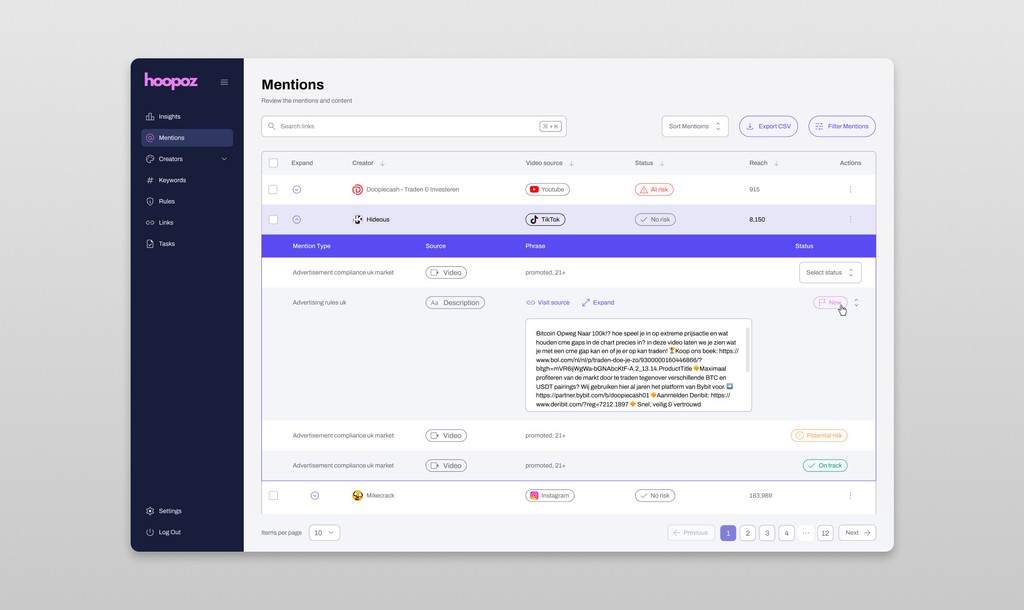
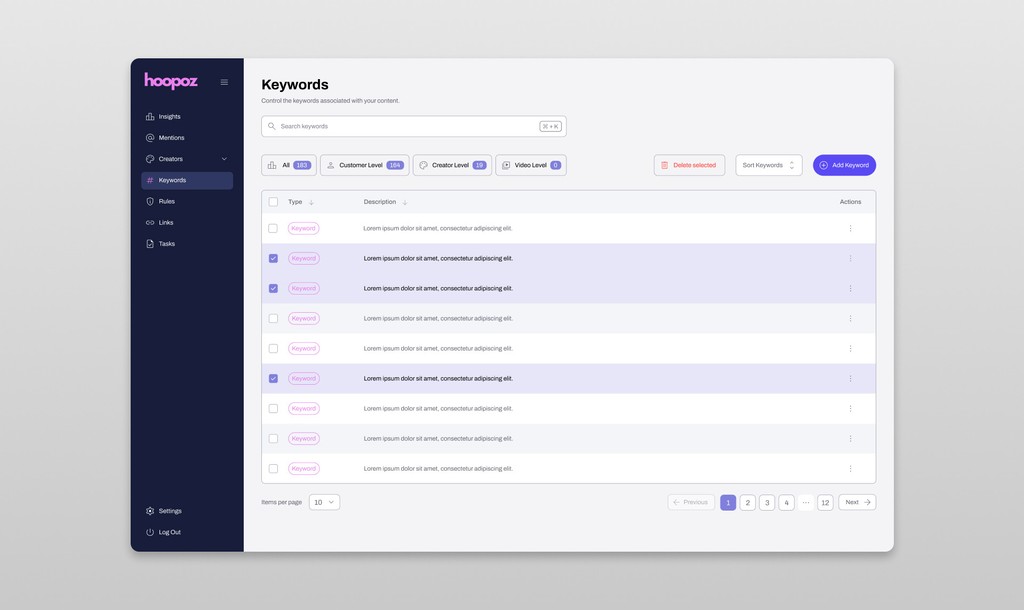
Sentiment, search and compliance got the same treatment: same type scale, same spacing, same navigation, same cards. When everything behaves the same way, brand teams stop relearning the product every time they switch features.
Handed over, and one thing I keep relearning
The dashboard, search, sentiment and compliance surfaces went to the internal team for the production build. The point was never polished mockups for a portfolio; it was a direction the engineers could follow and extend.
The thing this project confirmed for me: sometimes the most valuable design work is not a new feature but making the existing ones feel like they belong together. A product that feels coherent earns trust faster than one that can do more but makes you work harder to find it.
- Mine
- Information architecture, the redesign of the four core surfaces, the interaction language
- Hoopoz
- The AI, the brand, product priorities, and the production build